- calendar_today August 15, 2025
The Truth About Species (1995): Behind the Alien Seductress
This past month was a sad one in Hollywood, with the news of the passing of actor Michael Madsen, a fixture of gritty action films for nearly five decades. A film fan might point to his iconic roles in Reservoir Dogs or Kill Bill. A crime drama enthusiast might instead cite his compelling performance in Donnie Brasco. His extensive resume covers scores of roles, though with a few exceptions, most actors’ retrospectives have overlooked his appearance in the 1995 cult classic sci-fi horror film Species.
Directed by Roger Donaldson (No Way Out, The Bounty), the thriller was one of several creature features and alien-visitations-of-Earth films that dominated Hollywood during the ’80s and ’90s. It started when, at the behest of the United States government, two transmissions were sent from outer space: one outlining the process for a revolutionary fuel source, and the other containing detailed instructions on how to splice alien DNA with human DNA. The U.S. government, naturally, acts. The genetic experiment, headed by the nefarious Dr. Xavier Fitch (Ben Kingsley), begins the process of merging human and alien DNA to form a hybrid organism, a.k.a. Sil. (In her younger years, Sil is played by Michelle Williams.) A government team of scientists and specialists expects to engineer a mild-mannered, docile, controllable creature for study. Instead, they get something altogether different.
Sil matures at an alarming rate, entering puberty at an estimated three months. She has violent dreams and unexplained episodes where it seems she is anything but “controllable.” When Fitch decides the experiment has gone too far and releases cyanide into her holding chamber to kill her, Sil instinctively fights her way out and is on the loose.
Preston Lennox (Michael Madsen), a hardened black ops mercenary, teams with molecular biologist Dr. Laura Baker (Marg Helgenberger), anthropologist Dr. Stephen Arden (Alfred Molina), and a moody empath named Dan Smithson (Forest Whitaker), who has an uncanny ability to sense Sil’s moods and predict her movements. Together, this team chases Sil from New York City to Los Angeles, where the grown-up Sil (Natasha Henstridge), now highly intelligent and skilled in disguise, sets about her mission: to have sex and reproduce. It’s when she is introduced to humans by a nightclub owner that the body count begins. A grizzled train tramp, a thug’s hooker girlfriend, and, of course, Preston Lennox’s hot young paramour get in her way and become collateral damage in a race to stop the experiment before she can have children.
The Creature
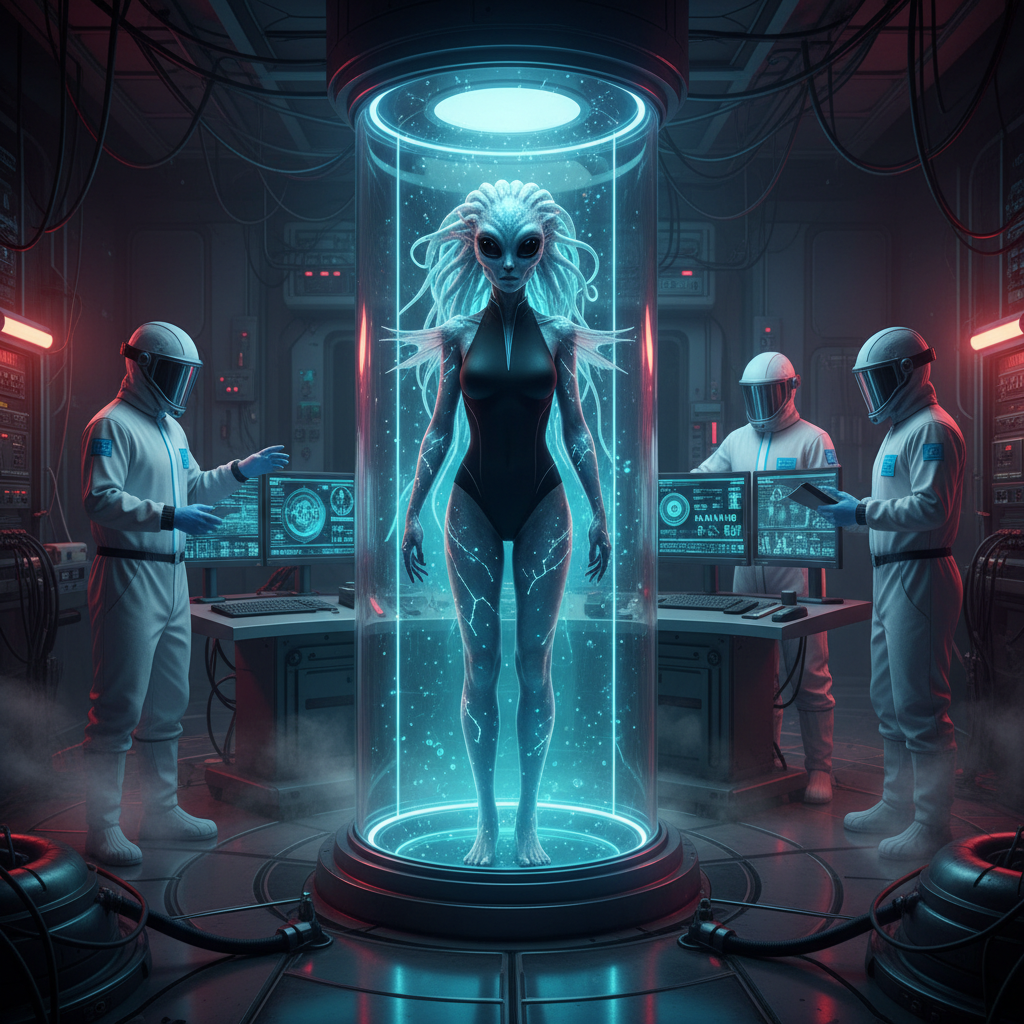
Species’ creature designer was one of science fiction cinema’s most legendary artists: H.R. Giger, whose best-known design was that of the alien in Ridley Scott’s 1979 film Alien. “She was an aesthetic warrior,” Giger said of Sil. “But also sensual and deadly.” Described as a “sorceress” with “tentacular bone structures,” Giger wanted Sil to be “amazing in shape and texture.” Sil’s final adult form “looked as if she had a glass body but with carbon inside.” In concept art, Giger designed multiple possible stages of the creature’s alien evolution, though due to production constraints, only one evolution (a cocoon form, which she sheds at the end) and her final form (mom alien) were included in the film.
Giger, who passed away in 2014, was not especially pleased with the finished product. He felt that Species too closely resembled his original Alien project and that screenwriter Mark Verheiden cribbed too much from his Alien film work, most specifically with Sil’s punching tongue and the infamous, gruesome climactic birth scene, a clear rip of the chestburster moment from Alien. Giger even stopped the production while it was still in pre-production to demand that Sil not be killed by a squad of flame-throwers, as he thought that too closely mirrored similar scenes in Alien 3 and Terminator 2.
Species was not the sort of movie that critics lauded, and while the dialogue can be serviceable, the characters themselves are thin and underdeveloped. Ben Kingsley’s Fitch is an amoral washout, and Forest Whitaker’s empath mostly serves as a plot device while offering exposition and generally stating the obvious. The themes, such as bioethics, first contact, and maternal instinct, are merely there to be suggested rather than given any depth. And yet, there is an undeniable attraction to the movie’s odd mash-up of science fiction and erotic horror.
Feldman was inspired by an article by Arthur C. Clarke, one of the architects of the space age, who had a theory about the lack of extraterrestrial visitation: Clarke thought that there might never be alien contact due to the low likelihood of faster-than-light travel. What if, Feldman wondered, rather than just creating the technology to contact Earth, aliens had visited with blueprints on how to use existing technology to engineer a living organism out of the DNA already found on this planet? His spec script created a fusion of creature feature and cautionary tale that has been panned by some and embraced by others. It won’t replace either Alien or Terminator 2 in the pantheon of sci-fi classics, but it did manage to create a following of its own.
Henstridge’s performance was a highlight, as was Madsen’s curmudgeonly turn, as was Giger’s iconic design. Three decades on, Species is a reminder of what science fiction looked and felt like when style trumped substance and a time capsule of the forgotten roles that defined the careers of actors such as Madsen.