- calendar_today August 8, 2025
.
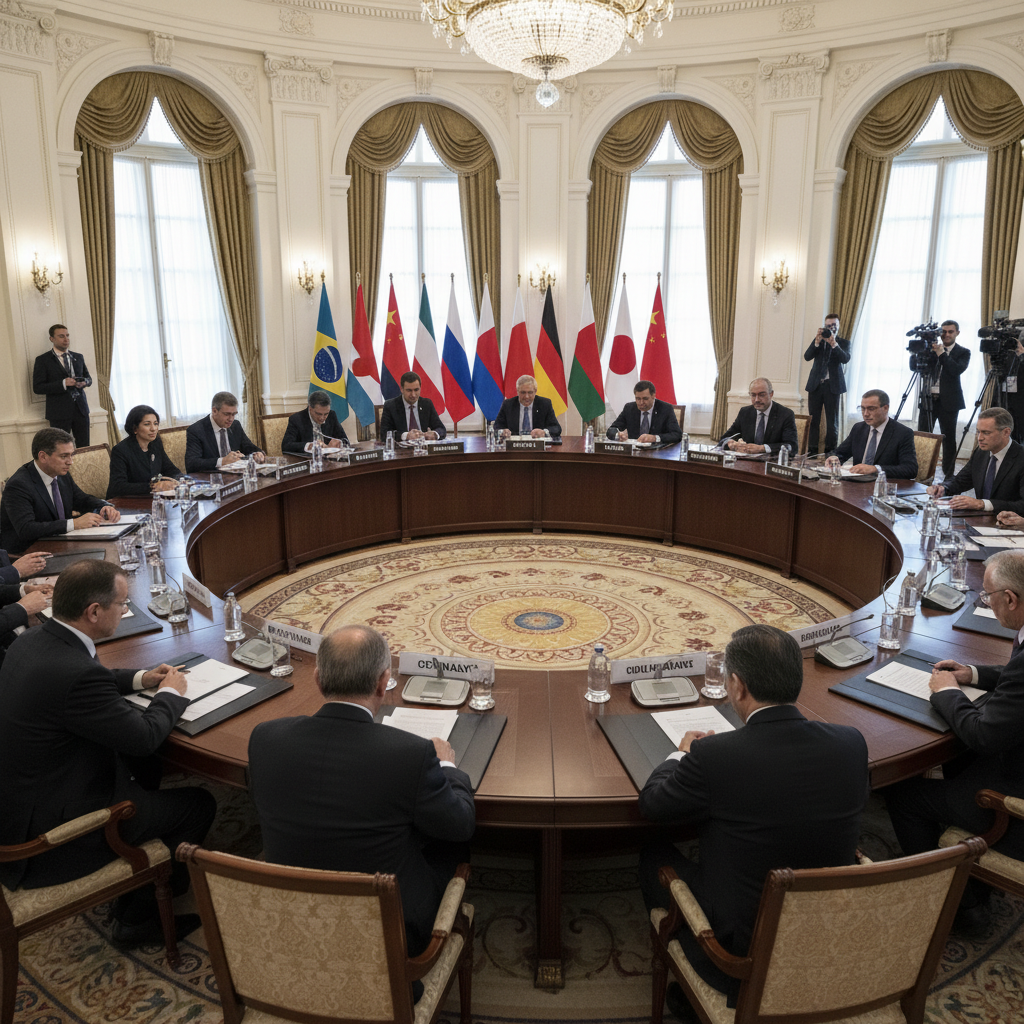
President Donald Trump is burnishing his image as a “global dealmaker” and on Monday he said he has ended six wars in his second term. The declaration was made in a White House meeting with the president of Ukraine Volodymyr Zelensky and a group of European leaders, with Trump promising further progress in resolving the ongoing war in Ukraine.
“I’ve done six wars — I’ve ended six wars,” Trump said in the meeting. “Look, India-Pakistan, we’re talking about big places. You just take a look at some of these wars. You go to Africa and take a look at them.”
The White House has been trumpeting Trump’s record as the “President of Peace” in recent weeks, including with an earlier statement listing claimed achievements in Armenia and Azerbaijan, Cambodia and Thailand, Israel and Iran, Rwanda and the Democratic Republic of the Congo, Egypt and Ethiopia, and Serbia and Kosovo. Administration officials have also pointed to the Abraham Accords of his first term that normalized ties between Israel and several Arab states.
False or substantial?
His latest claims have drawn skepticism about whether he is delivering substantive solutions or simply using ceasefires and calling them historic peace agreements. In the case of Israel and Iran, a truce was called that halted 12 days of fighting, though the core issue of Tehran’s nuclear ambitions remains unresolved.
His track record in previous cases has also shown the limits of his intervention. Ceasefires to stop fighting between Israel and Hamas fell apart, and first-term summits with North Korean leader Kim Jong Un concluded with no movement on ending Pyongyang’s nuclear program, leaving the hermit state with a bigger arsenal.
But he has been able to claim at least some symbolic achievements. This month Armenia and Azerbaijan signed a White House declaration committing to recognize each other’s borders and eschew violence. They also signed a U.S.-backed transportation corridor, which the two leaders called the “Trump Route for Peace and Prosperity.” Azerbaijani President Ilham Aliyev said the agreement was “a miracle” though territorial disputes that analysts say will be difficult to resolve remain on the table.
Applied pressure
Trump’s actions in Southeast Asia showed how he has used U.S. economic clout to try to halt violence. Fighting between Cambodia and Thailand over a disputed border had left 38 people dead by the time he stepped in, and Trump threatened to suspend trade deals with both governments unless they ceased the fighting. Final agreement was helped by the Association of Southeast Asian Nations (ASEAN) regional bloc, but Cambodian Prime Minister Hun Manet credited Trump and nominated him for the Nobel Peace Prize for his “extraordinary statesmanship.”
A similar approach was taken in May when he intervened in a flare-up between India and Pakistan on a shared border. Pakistan welcomed Washington’s involvement but India downplayed the U.S. role. The ceasefire has been tenuous and the long-running dispute over Kashmir remains on the table and could flare up again.
He has also claimed credit for progress in Africa, highlighting a deal signed by Rwanda and the Democratic Republic of the Congo calling for border recognition and disarmament of militias. But the M23 rebel group, which helped spark the conflict, rejected the deal, and it’s unclear if it will hold. There are also U.S. strategic motives in play with the agreement being seen as bolstering Washington’s position in a resource-rich continent where it is competing with China for influence and mineral rights.
The claims Trump has made about Egypt and Ethiopia involve their years-long standoff over an enormous dam on the Nile River. Trump has been pressing for a compromise, but no binding deal has emerged. The administration also cites Serbia and Kosovo taking steps to normalize relations, including during Trump’s first term, but the two countries remain at loggerheads, with recent talks driven mainly by the European Union.
Achievements to back claims
Trump’s in-your-face diplomatic style — punctuated by bombastic pronouncements and efforts to brand himself on every agreement — has yielded mixed results. The scaling back of the State Department and Trump’s cuts to the U.S. Agency for International Development that have been rolled back by Congress undermine America’s ability to foster the quiet diplomacy needed to make short-term deals stick as durable peace.
But some observers also point out that his interventions have in some cases been effective. Celeste Wallander, former assistant secretary of defense who now is at the Center for a New American Security, said his handling of India-Pakistan tensions was “done in a professional way, quietly, diplomatically, with people on the ground … trying to find common ground between the parties.”
The question now is whether his track record is a harbinger for Ukraine. The evidence to date shows both: headline-grabbing agreements that stop well short of lasting peace alongside a few instances where U.S. pressure succeeded in de-escalating conflicts before they spiraled further.