- calendar_today August 9, 2025
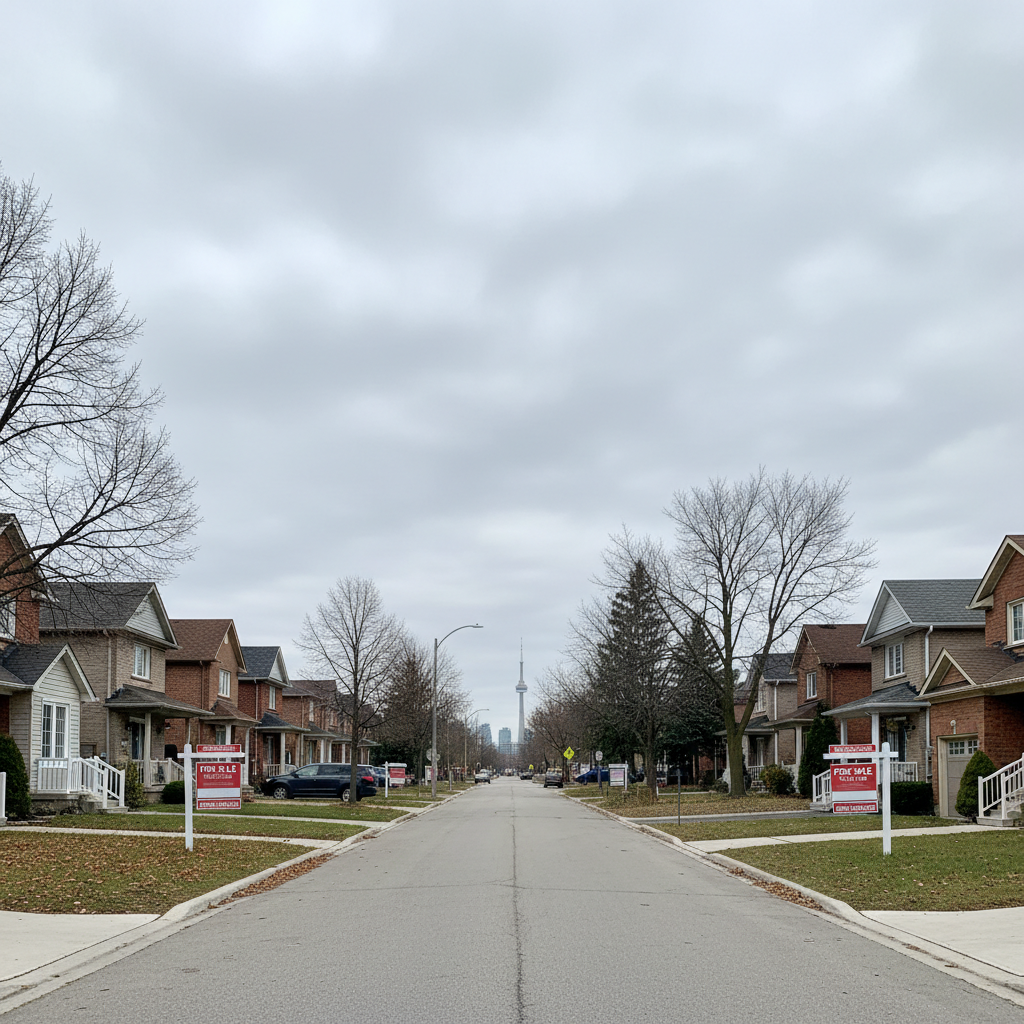
Toronto, ON – July 2025 — After years of explosive growth and bidding wars, Toronto’s housing market has entered an unexpected state of stagnation. As of mid-2025, both buyers and sellers are hitting the brakes, resulting in a sharp decline in transactions across the Greater Toronto Area (GTA). Despite expectations that 2025 would bring a rebound following the previous year’s economic uncertainty, the market has instead stalled.
This housing freeze isn’t just a seasonal slowdown—it’s a deeper, more structural pause shaped by interest rate pressures, affordability ceilings, and a growing hesitance among investors and homeowners alike.
Sales Activity Slows to a Crawl
According to data from the Toronto Regional Real Estate Board (TRREB), home sales in the GTA are down nearly 27% year-over-year. Detached home sales in the city’s core have dropped even more steeply, while outer suburban markets like Durham and Halton are seeing increased days on market and reduced multiple-offer scenarios.
Sellers aren’t rushing to list either. New listings are down by nearly 18%, signaling a lack of confidence in the ability to sell at previously seen peak prices. Homeowners are choosing to stay put, refinancing rather than risking a lower sale.
“We’ve gone from a frenzy to a freeze,” said Anita Kapoor, a real estate broker based in Scarborough. “Even well-priced homes are sitting longer, and buyers are waiting for either rate cuts or price drops.”
Interest Rates Continue to Dampen Demand
The Bank of Canada’s cautious approach to interest rate cuts in 2025 has kept mortgage rates elevated, hovering around 5.2% for five-year fixed terms. While the central bank has hinted at gradual easing, the cost of borrowing remains a deterrent for first-time buyers and investors.
Higher carrying costs, combined with already high home prices, have left many potential buyers sidelined. “It’s not that people don’t want to buy—it’s that they can’t afford to,” said financial analyst Marcus Tejada. “The stress test is still preventing many from qualifying for a mortgage.”
Affordability Crisis Hits a New Wall
Toronto remains one of the least affordable housing markets in North America. According to RBC’s Housing Affordability Index, more than 85% of median pre-tax household income is now required to cover mortgage payments on a typical home in the GTA.
As wages struggle to keep pace with inflation and housing costs, the demand profile is shifting. Entry-level buyers are increasingly looking outside the GTA—or even the province altogether—prompting concerns about a long-term talent drain from the region.
Condo Market: Resilient But Slowing
While detached and semi-detached homes are seeing significant price reductions, the condo market in downtown Toronto has shown relative stability. However, activity has still slowed compared to pre-2022 levels.
“Investors aren’t fleeing, but they’re more cautious,” said Talia Wong, a pre-construction consultant. “There’s hesitation around Airbnb regulations and ongoing rental price flattening.”
Vacancy rates have edged upward in some new builds, particularly in the Liberty Village, East Bayfront, and Etobicoke regions—areas previously considered hotbeds for rental income.
New Construction Faces Delays and Uncertainty
Developers across the GTA have pulled back on major projects or delayed launches due to both financing challenges and slower pre-sales. While the City of Toronto continues to push for higher density, especially near transit hubs, developers are now more selective.
“We’re entering a wait-and-see mode,” said Joseph Latif, a project manager with a major development firm. “It’s difficult to pencil out profitability when borrowing costs are high and buyers are hesitant.”
Immigration and Population Growth Still Apply Pressure
Despite the current freeze, long-term fundamentals remain strong. Toronto continues to experience significant population growth, driven by immigration and international students. These demographics will eventually require housing, but the timing mismatch between population demand and current affordability remains a major issue.
Federal and provincial programs to increase housing supply have yet to translate into enough move-in-ready inventory, further straining the already tight rental market.
Local Policies Still Lagging Behind
Housing advocates point to slow zoning reforms and a lack of clear rent control guidelines for new units as contributing factors to market uncertainty. Toronto’s ongoing battles with short-term rental enforcement and property tax assessments have also added friction to investor confidence.
Municipal delays in approvals and red tape for new housing construction have only deepened the freeze, despite political promises to “build faster.”
Who’s Affected Most?
The economic condition is influencing eveyone:
- First-time buyers face the double challenge of high prices and restrictive lending environments.
- Sellers are holding out for better pricing conditions but may miss the boat if interest rates decline slowly.
- Developers are stalling new projects, potentially deepening the long-term supply shortage.
- Investors are pausing acquisitions, watching for government changes to tax and zoning policies.
The Road Ahead: Will the Market Thaw in Late 2025?
Experts are divided on how soon Toronto’s housing market will begin to recover. Some anticipate moderate recovery in Q4 2025 if the Bank of Canada lowers rates further. Others believe it will take until mid-2026 for consumer confidence and affordability to realign.
“The fundamentals haven’t changed—Toronto is still a growing, global city,” said Tejada. “But the market needs breathing room. This reset might actually prevent a crash later.”
Toronto’s housing market freeze in 2025 is a significant shift for a city used to perpetual motion in real estate. Though the long-term trajectory remains upward due to demand fundamentals, the current stall is reshaping how and when people choose to buy, sell, or invest.
Whether this is a temporary cool-down or the start of a structural recalibration will depend on how interest rates, affordability, and public policy evolve in the coming months. For now, Toronto sits in a rare pause—waiting to see where the next turn takes the market.