- calendar_today August 12, 2025
.
Washington and New Delhi heralded their once-close relationship as one of the most successful strategic partnerships of the post–Cold War period. But that relationship is being tested as the ties fray amid tariffs and oil purchases that are rapidly driving New Delhi into the arms of Delhi’s strategic rivals.
“The trust is gone,” Evan Feigenbaum, a South Asia analyst at the Carnegie Endowment for International Peace, told Foreign Policy. “We’re in a situation in the U.S.-India relationship where the premises and assumptions of the last 25 years … that everybody worked very hard to build, including the president in his first term, have just come completely unraveled.”
The trouble began earlier this year when President Donald Trump levied massive tariffs on Indian imports in response to New Delhi’s ongoing purchases of Russian oil despite the war in Ukraine. The tariffs, which began at 25 percent and are slated to double to 50 percent on August 27, have not so far had the desired effect of dissuading India from buying Russian oil. Instead, the Indian government appears to have doubled down on its purchases and, in response, grown even closer to Moscow and Beijing in recent months.
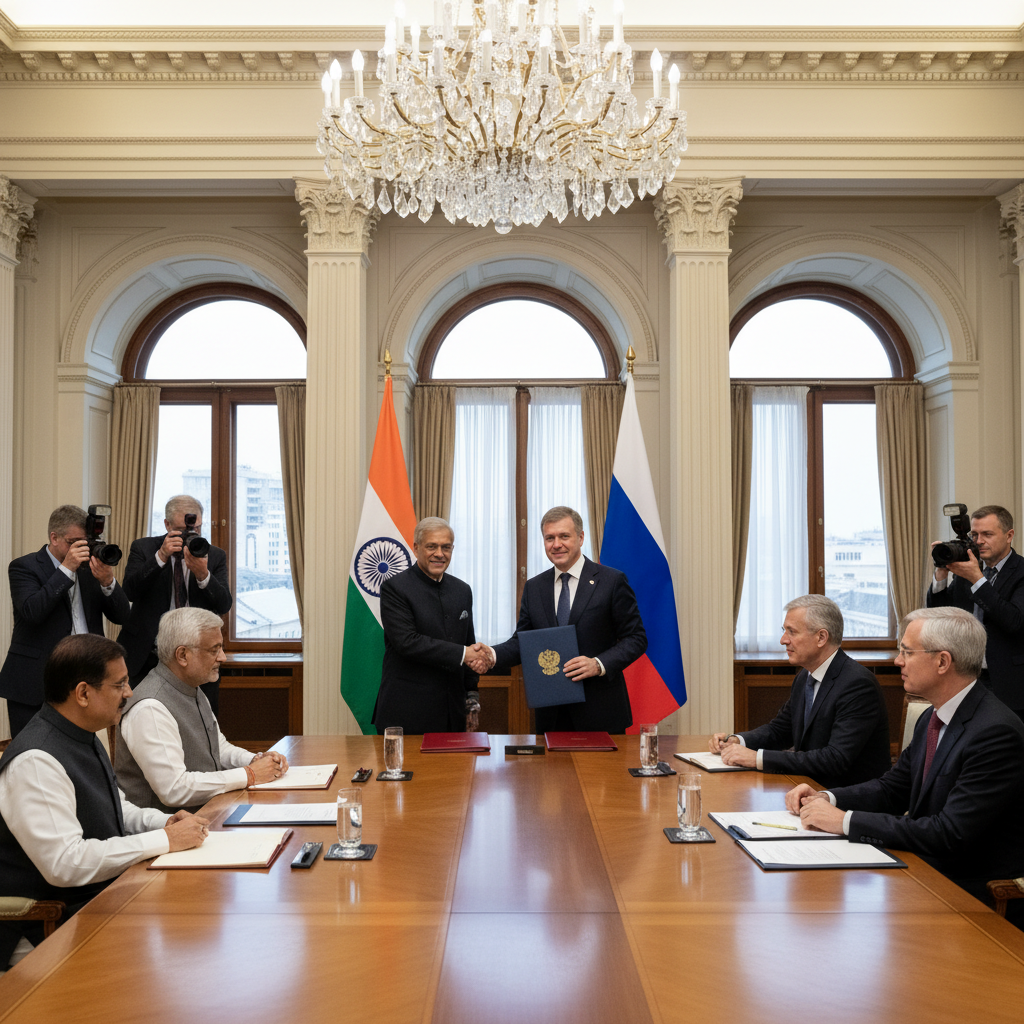
India’s national security adviser visited Moscow last week, Foreign Minister Subrahmanyam Jaishankar held talks in the Russian capital earlier in the month, and Chinese Foreign Minister Wang Yi has just wrapped up meetings in New Delhi. Indian Prime Minister Narendra Modi is expected to make his first visit to China in more than seven years in the coming weeks, and Russian President Vladimir Putin is also set to host Modi in Moscow before the end of the year. The pivot eastward is more than just a matter of symbolic diplomacy, experts say.
The Trump administration’s policies have also soured Indian public opinion, which has turned sharply against perceived U.S. meddling in the country’s decision-making on sensitive strategic issues. “They’re signaling very clearly that they view that as interference in India’s foreign policy and that they are not going to put up with it,” Feigenbaum said.
Modi had drawn back from encouraging Indian state-run refiners to buy Russian oil in the opening days of the Ukraine war, but attractive discounts of six to seven percent convinced the government to resume imports, leading to a doubling of Russian oil purchases throughout the war to 35 percent of India’s crude imports, up from 0.2 percent in February.
Russia has also increased its offerings to the Indian market since the invasion began. “Moscow will continue to supply Indian companies with crude oil, oil products, thermal coal, coking coal, and sees potential for the export of Russian LNG,” Deputy Prime Minister Denis Manturov said in a statement last week.
The Trump Factor
India’s dalliance with Moscow has continued even as Trump announced his latest round of tariffs. But the U.S. president is hardly alone in responsibility for New Delhi’s recent shift in strategic calculus.
“In a way, this has been building for almost a year,” said Michael Kugelman, a South Asia analyst at the Washington-based Wilson Center. “We’ve seen indications for almost a year of India wanting to ease tensions with China, strengthen relations with China, mainly for economic reasons. But I think the Trump administration’s policies have made India want to move even more quickly.”
Feigenbaum noted that some of New Delhi’s recent actions have “a performative aspect,” but some “are not performative at all. India is going to double down on some aspects of its economic and defense relationship with Russia — and those parts are not performative.”
New Delhi had already been pivoting away from Moscow on defense before the Ukraine war, moving to diversify away from Russian arms and toward U.S., French, and Israeli military systems. But that purchase of Russian weapons has been largely matched by a ramping up of energy imports once the Ukraine invasion began. “It’s telling the United States that, well, ‘you don’t have to be trusted because you and your friends can turn on us at a moment’s notice,’” Kugelman said. “The important takeaway for India from this is that the U.S. can’t be trusted, whereas Russia can — because Russia is always going to be there for India no matter what.”
In Washington, criticism is growing. Peter Navarro, the former Trump White House trade adviser, wrote in an op-ed for the Financial Times this week that India’s purchases of Russian oil are “opportunistic” and “deeply corrosive” to U.S.-India ties. Tariffs “target India where it hurts — its access to U.S. markets — even as it seeks to cut off the financial lifeline it has extended to Russia’s war effort,” Navarro wrote.
In 2008, the two sides sealed a U.S.-India civil nuclear deal, allowing India to import fuel and technology from the United States despite its refusal to sign the Non-Proliferation Treaty. The episode was also rife with friction, but the two countries successfully compartmentalized their disagreements so as not to poison the well of U.S.-India relations.
Today, the compartmentalizing appears to have come to an end. U.S. governments of both parties have long seen India as a natural ally in their effort to build a free and open Indo-Pacific to counterbalance China. The relationship is quickly deteriorating into one in which “defense cooperation, intelligence cooperation is all going to suffer,” Kugelman warned.
“If countering China has been the glue that has bound this relationship together in recent years, if it continues this free fall, then I don’t know how it will be able to sustain that kind of cooperation in the future,” he added.
“It’s just so ironic because then, India was working with us as part of its partnership to signal to then-foe China that India had options. Now they’re working with the Chinese to signal Washington rather than the other way around,” Feigenbaum said.