- calendar_today September 2, 2025
Apple may have found a way to avoid Donald Trump’s trade war: flattering the president’s ego. On Wednesday, Trump announced Apple would avoid an impending 100 percent tariff on semiconductors that would have jacked up iPhone prices around the world. Reuters reported the exemption was granted the same day Apple said it would invest another $100 billion in the U.S. and gift the president a personalized statue.
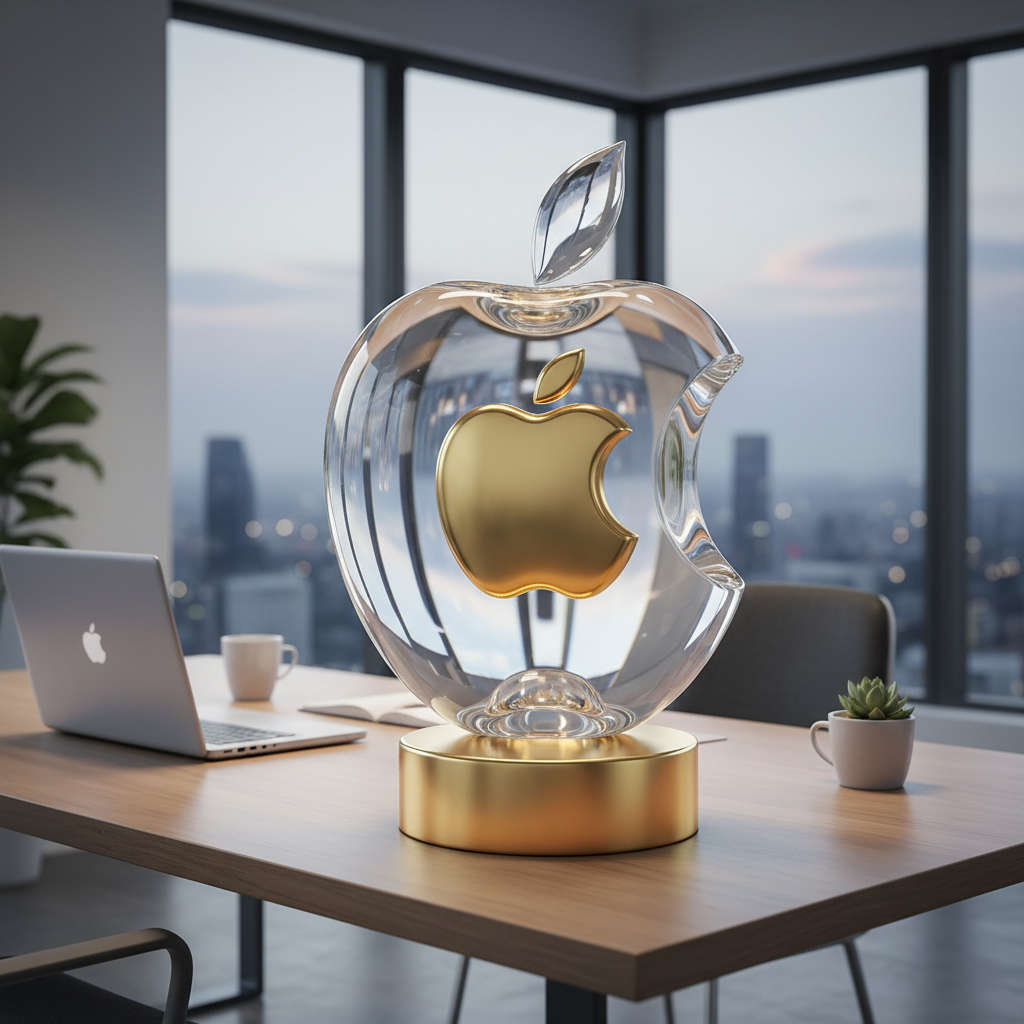
Cook said the 15-inch-tall statue was made by Corning, an Apple supplier for two decades known for specialty glass in iPhones. The statue, created by an ex-U.S. Marine Corps corporal who now works at Apple, was cut into a big circle of glass with a large Apple logo at its center. Cook said it was from Utah and had a base made of 24-karat gold with Trump’s name etched in. Cook finished the statue with his own personalized note: “Made in America.”
Trump, who has long railed against corporations to produce more goods at home, seemed to receive the gift with relish. In the Oval Office, Trump confirmed that Apple — as well as any other company that builds plants in the U.S. — would face “no charge” when semiconductor tariffs are officially put into place. The decision is a major win for Apple, which has been subject to months of Trump’s public pressure on where it builds its supply chain.
In recent months, however, things had only gotten bumpier. Trump had hammered Apple for shifting iPhone production to India rather than the U.S. In April, he claimed trade policies would help “Made in America” iPhones come to market. In May, he was even more direct, acknowledging in the Middle East that “I have a little problem with Tim Cook.” Trump reportedly later told Cook directly, “We are treating you really good, we put up with all the plants you built in China for years. We are not interested in you building in India.”
Analysts, however, have pointed out that making iPhones in the U.S. would be a huge logistical lift that could take years to make happen, if it could happen at all. But the Trump administration insisted such a move was a real possibility. Commerce Secretary Howard Lutnick said that Apple is at least looking into “robotic arms” that could replace the highly-skilled Chinese workers who make Apple’s products.
Cook has his own charm offensive. And Apple’s latest moves on Wednesday suggest Trump has backed down from his demands. Trump threatened in the past to levy a 25 percent tariff on Apple if it failed to shift to assembly in the U.S. For now, however, he has deferred that and instead trumpeted Apple’s moves as “a significant step toward the ultimate goal of ensuring that iPhones sold in America also are made in America.”
Cook has also pledged that Apple already makes some components — semiconductors, glass, Face ID modules — in the U.S. He has not said when assembly could happen stateside, though. In his comments, he only suggested it “would still be overseas for a while.”
Apple knows this playbook all too well. Cook successfully wooed Trump in his first term with promises of investment and production in the U.S. while skillfully dodging the president’s harshest requests. In 2017, Trump promised that Apple was in the process of building three “big, beautiful” plants in the U.S. The company ultimately only built one, and it was not for iPhones or other electronics, but for face masks. In 2019, Trump even took credit for an iPhone-manufacturing plant in Texas. Apple instead pledged to make MacBook Pros, again thwarting Trump’s “Made in America” vision.
This time, Apple has promised a total of $600 billion in investment in the U.S. over four years. The number sounds big, but in reality just reflects how much Apple has already promised to spend in the U.S. during Trump’s previous term as well as the Biden administration, Reuters noted. It is what Apple has said it would do anyway.
Trump has said companies that don’t invest in production in the U.S. could face retroactive tariffs. But Apple is currently continuing to follow its standard investment timeline and keep production of iPhones abroad. The tariff calculation has not changed. And at least for now, Trump has decided not to force the issue.
Wall Street sees Apple’s move as a smart one. Nancy Tengler, CEO and CIO of Apple investor Laffer Tengler Investments, told Reuters that the strategy is “a savvy solution to the president’s demand that Apple manufacture all iPhones in the U.S.”
Cook’s mixture of personal touch, symbolic gestures, and strategic investment has thus far staved off Apple’s involvement in the trade war. Trump can claim progress on “Made in America” as he likes, but Apple is all but certain to keep the most labor-intensive aspects of production abroad. For now, it can do so without tariffs.