- calendar_today August 20, 2025
A new artificial intelligence model called LegoGPT from researchers at Carnegie Mellon University can turn text descriptions into stable Lego structures. The innovative system stands out because it translates text descriptions into Lego designs that can be physically built either by humans or robots. LegoGPT functions based on the core ability to transform text instructions like “a streamlined, elongated vessel” or “a classic-style car with a prominent front grille” into exact Lego brick placement sequences that produce a structurally sound object.
An autoregressive large language model learned to translate textual instructions into stable Lego configurations by being trained on a dataset of over 47,000 physically stable Lego designs paired with descriptive captions from OpenAI’s GPT-4o. The training process teaches AI systems to associate language patterns with stable Lego structures so they can determine which brick to place next to keep the structure sound.
The Inner Workings of LegoGPT
While LegoGPT utilizes foundational concepts from large language models similar to ChatGPT, its primary focus shifts from predicting the next word to predicting the next brick. The researchers enhanced Meta’s LLaMA-3.2-1B-Instruct instruction-following model by fine-tuning it and integrating a specialized software tool that employs mathematical models to simulate both gravitational forces and structural stability in order to validate the physical durability of designed structures. The “physics-aware rollback” feature of LegoGPT detects potential design flaws during creation and refines the model by testing different brick placements, which boosts structural stability from 24 percent to 98.8 percent. The AI process creates a sequence of Lego bricks that are precisely positioned to avoid collisions while fitting inside the building envelope. Mathematical models verify that completed designs maintain structural integrity and remain upright after completion.
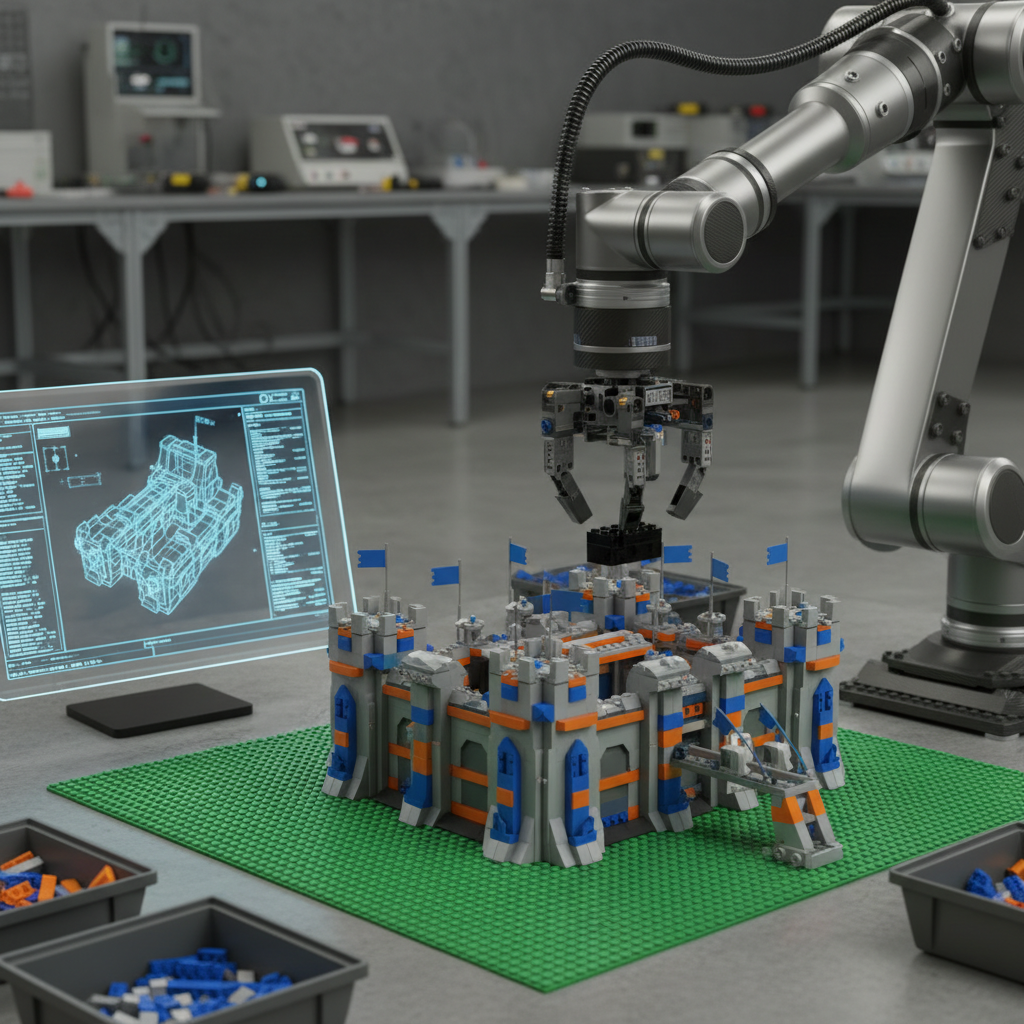
Researchers tested the practical usability of LegoGPT designs by performing intensive experiments with robots and people who constructed the models. Researchers used a dual-robot arm system with force sensors to assemble AI-created models by following pre-determined brick sequences. Human testers actively engaged in the evaluation process by building AI-created designs by hand, which confirmed that LegoGPT generates Lego structures that are buildable and stable while maintaining fidelity to the original text prompts. The experiments proved the system’s capacity to transform textual descriptions into Lego models that match both the design intent and structural stability needed for physical assembly. The ability of both robots and humans to construct structures confirms the practical and resilient nature of the AI-generated building instructions.
LegoGPT stands apart from other AI models dedicated to 3D creation, such as LLaMA-Mesh, since its core mission revolves around maintaining structural integrity. The team’s evaluations demonstrated that their approach produced a significantly greater percentage of stable structures than other methods, which usually focus more on visual detail than structural viability. LegoGPT functions in a fixed 20×20×20 construction area with only eight standard Lego brick variations available.
The researchers identified these limitations and created future development strategies to enhance LegoGPT for handling bigger and more intricate designs with a larger assortment of brick types, such as slopes and tiles. The development of the system will necessitate enhancements to both the AI model and physics simulation to handle more complex designs. LegoGPT’s achievement in combining language understanding with physics simulation represents a breakthrough for AI-driven physical construction design.
The Broader Implications of LegoGPT
LegoGPT offers implications that surpass its basic function of creating Lego models. The system can convert abstract text descriptions into real-world structures that prioritize structural stability and buildability, which indicates possible uses in architecture and engineering disciplines. Designers could verbally describe structural components or robotic assemblies for an AI system to create detailed, buildable instructions with stability analysis in future scenarios. The approach enables designers to achieve smoother workflows while cutting down mistakes and opens up the making of complex structures to more people. The progressive evolution of AI technology enables systems such as LegoGPT to create more natural design processes while enhancing fabrication across multiple sectors, thereby merging digital creation with tangible reality.
LegoGPT marks a major advancement in AI-powered design by showing its ability to create structures that are both visually attractive and physically buildable from textual descriptions. Through its emphasis on basic stability principles and constructability, this system establishes an unprecedented standard for AI in physical creation and suggests a future where AI becomes crucial for turning digital designs into a tangible reality.