- calendar_today August 11, 2025
Toronto’s economy waits and watches as the Federal Reserve halts interest rates. How will businesses, real estate, and consumers manage with sustained high borrowing prices?
Toronto Watches Closely As Fed’s Monetary Policy Is Put on Hold
Toronto, Canada’s economic epicenter, is closely monitoring the Federal Reserve’s recent decision to pause interest rate cuts. As borrowing costs remain elevated, Toronto’s financial markets, real estate sector, and consumer economy are all feeling the pressure. The question now looming over the city is how long this high-rate environment will last—and how Toronto will adapt to the new financial landscape.
While having a U.S. base, Federal Reserve policies resonate across borders, particularly in Canada. As both nations’ inflation is easing but not yet under control, the Federal Reserve’s conservative approach is forcing the Bank of Canada to move with caution as well. This implies that the anticipated rate reductions that will ease the pain for businesses and households could be postponed.
The Federal Reserve’s Impact on Canadian Monetary Policy
Although the Federal Reserve’s rate actions are not mandatory for Canada, their effects cannot be denied. Canada’s economic environment is strongly linked with that of its southern counterpart, particularly in trade, investment, and banking. With the Fed keeping its benchmark rate to control inflation and economic growth, the Bank of Canada would be reluctant to cut rates unilaterally for fear of depreciating the Canadian dollar or capital flight.
For Toronto—a city with intense debt-financed exposures such as real estate, infrastructure, and tech—the Fed’s rate pause actually extends tight money conditions. That is particularly meaningful as the city struggles with increased costs, inflationary lag, and weakening international demand.
Real Estate Market Struggles with Rate-Induced Uncertainty
Toronto’s housing market, traditionally one of the most active and costly in North America, is adapting to a new environment influenced by high mortgage rates and stricter lending rules.
Buyers are taking a wait-and-see approach, expecting a hint of rate reductions. New buyers and first-time buyers are being deterred by hefty monthly payments.
Sellers are lowering their sights. Houses are lingering on the market for longer, and price drops are becoming more frequent to encourage hesitant buyers.
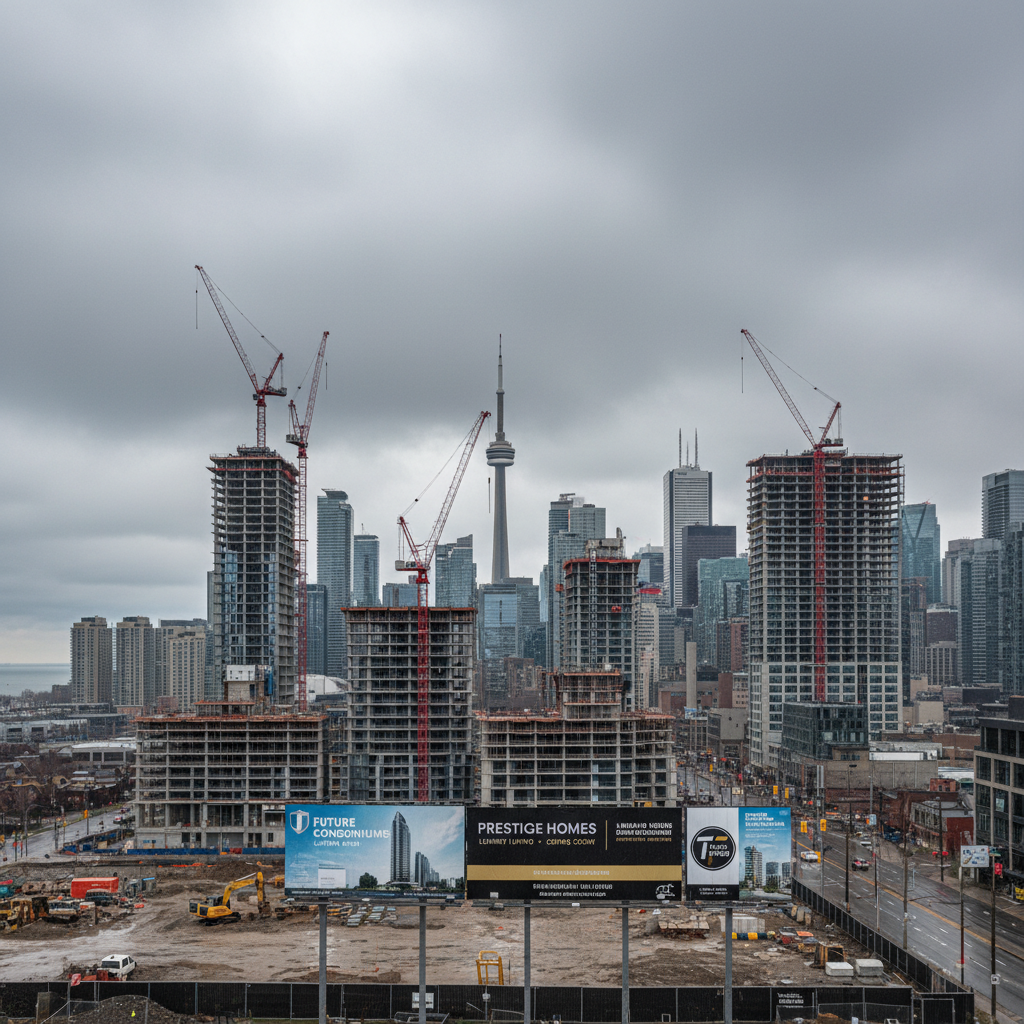
Developers are tapering the construction pace for higher financing costs and risk of uncertain demand, aggravating the current housing supply shortage.
In spite of these impediments, the city’s long-term housing shortage and robust immigration-driven demand prevent the market from a sharp downturn. Affordability still remains a serious issue for buyers and renters.
Businesses Hold Back on Investment and Expansion
Toronto’s diversified economy—led by finance, technology, real estate, and creative industries—is going slow in reaction to persistent high borrowing rates.
Startups and small businesses are having an increasingly tough time obtaining venture capital or cheap credit, slowing innovation and growth.
Large firms are pulling back on hiring and postponing major capital investments in the face of economic uncertainty.
Foreign buyers, particularly those considering commercial property or infrastructure, are holding back because of more expensive financing and unstable currency levels.
Toronto’s economic heart is still solid, however. Emerging sectors like clean energy, artificial intelligence, biotech, and digital finance are moving ahead even as older industries become increasingly conservative with capital.
Consumers are Under Pressure from Ongoing Rate Increases
On the consumer side, people throughout Toronto are making lifestyle and budget changes to adjust to the effect of increased rates on daily budgets:
Personal loans and credit card debt are becoming pricier, prompting consumers to cut back on discretionary spending.
Auto financing and car loans have decelerated, impacting dealers and supporting industries.
Retail sales—specifically in discretionary categories—are weakening as families cut back on rent, groceries, and utilities.
These shifts would potentially have long-term effects on the small businesses and service sectors with consumer-led streams of income.
Market Outlook: What’s Next for Toronto’s Economy?
The Federal Reserve’s reluctance to cut interest rates again serves as an indicator of holding pat while inflation dynamics continue to play out. This is also expected to be mimicked by the Bank of Canada, particularly amid inflation rising above its 2% benchmark while uncertainty about world economic performance still lingers.
Yet, if inflation keeps reducing over the next few months, rate reductions are a possibility in the latter half of the year. Such action will provide huge relief to Toronto’s housing market, firms, and credit-consumer segments. Otherwise, Toronto will have to sail through a high-interest-rate regime with planning, guarded optimism, and keen observation of global developments.
Conclusion: Resilience Amid Uncertainty
Toronto’s economy is adjusting to a protracted period of high interest rates, guided by the Federal Reserve’s conservative approach and echoed by the Bank of Canada. As the high cost of borrowing penalizes the real estate sector, business investment, and household behavior, the city’s resilience as an economy—driven by diversity, innovation, and global connections—remains a fundamental strength.
As markets continue to develop, all eyes will continue to watch central banks waiting to see when relief might eventually come.